
THE CALL FOR CREATIVITY, JOY, ONE V. ONE ABILITY AND THE NECESSARIES
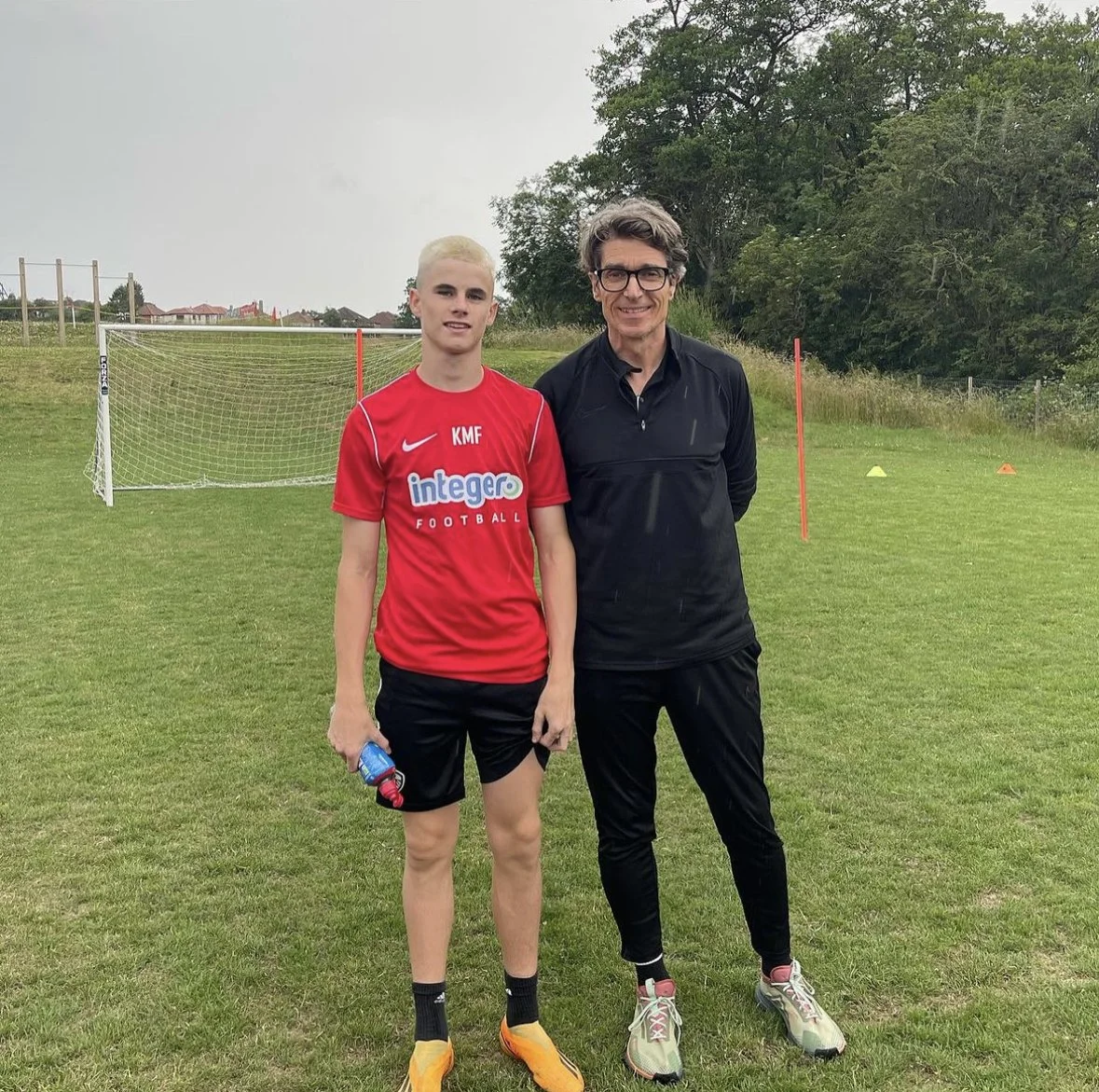
©INTEGER FOOTBALL
During their first ever Champions League-winning campaign, Paris Saint-Germain reminded us last season that the ability to run at players, to beat players, and to have guile, disguise and deception in one-on-one situations is at the core of why many people play football and why most of the world watches it. Their high energy style and strength in one-on-one attacking duels had the beating of many top European clubs, and is proving the same in this campaign, with a rampant win at home in the knockout stages and one of the most attacking games seen in recent years earlier this week.
I've heard much in recent months from young people telling me that they're not enjoying watching football, and certainly from older people who remember a slightly different game. What is more, people within the game and people working at a high level have explained to me that they too can get fed up with it. One ex-player I used to work with who is now a friend of mine recently told me that he is really disliking watching football at the moment. I think a big part of it is that the joy is being sucked out of the game; an over-reliance on set pieces and data is casting a shadow over the fun and joyful nature of the beautiful game. Which is exactly that - a game, to be played! Ruud Gullit recently said in an interview that he is ‘waiting for players who will take on defenders again, someone like Lamine Yamal’, further saying he is ‘missing the joy’. Gullit explained that ‘everyone is just executing tasks on the pitch. Where are the players dribbling?’ he asked, calling for courage. ‘Why is everyone passing, passing passing?’ Football has been systemised, and players are just carrying out tasks, rather than being creative.
System football per se is nothing new. Football historians would suggest that it actually started in the early 1960s, and indeed also had some opposition then. During the 1963 European Cup Final, AC Milan’s Pivatelli injured Benfica’s great Portuguese forward Coluna with an extremely late challenge, breaking a bone in his foot. In the days before substitutions, it was a foul that pretty much decided the game. AC Milan went on to win 2-1; the age of individualism was changing to the age of the system. The Milan coach denied there was a plan to target Coluna, but his approach to use Pivatelli to deal with Coluna was a major contributory factor, and was a new way to view the game. He was part of the new generation that saw the team as a system of 11 component parts, not 11 individuals. Inter Milan followed AC, winning the 1964 and 1965 European cups using the soon-to-be notorious defensive system catenaccio, that many Italian clubs had been utilising. On these shores, defeat to Hungary in 1953 sent English football into introspection, and brought about a new generation of British system coaches. Within a few years Shankly and Revie were two of the most notable, and when playing in the 1965 FA Cup final against each other, the game was deemed as unwatchably tedious, with patient build up being preferred over individual attack and brilliance. One year later though, it was system football that brought England the 1966 World Cup; a wingless formation unveiled by Sir Alf Ramsay in the quarter-finals. Whilst system football was seen as being rather defensive-minded, in the decade that followed Michels of Ajax and Lobanonskyi of Dinamo Kyiv proved that system football was also capable of being as offensive.
But of course, again now in 2026 we are seeing that people are not enjoying football enough due to the seemingly robotic nature of a lot of it, and the newer systems that have been put in place.
So, why is this? I think the 2006 World Cup was a big turning point. If Brazil had won that World Cup, football may have gone in a different direction. Brazil would have had six world championships. Ronaldinho would have been even more of a household name and possibly put up there among the greats in history. A Brazil win would have changed perspectives and opinions on football significantly.
As a result of a non-free-flowing Italy winning it, and Brazil almost vacating their crown, there was a gap for someone to step in and create a new way of playing; Guardiola did it with Barcelona in the following years. This tactical evolution and new style of playing had Barcelona dominating Spain and Europe. He then took this to Bayern and had great success. Everything that has come in football since, and across the Premier League mostly, has been a product of this and Pep’s impressive body of work, even down to youth coaching in this country, which is possibly not necessarily a good thing overall (though it of course does have its positives).
This is not to take away from what Guardiola achieved. What he did with that class of players from the Barcelona B team was unbelievable. The tiki-taka football being played was so different. He took great influence from coaches in handball, and it was a style of football where the emphasis was on keeping the ball, keeping the ball, keeping the ball, waiting for the gap; waiting for the right gap. I do like it. I used to train that way with Brazilian Soccer Schools. We used to say, ‘wait for the good gaps; just keep it’. For its time, it was good and it worked. I was actually in Barcelona in the years just after Guardiola when Luis Enrique came in. I was with the club on two occasions and luminaries at the club told me that they got fed up with that style despite the trophies. It was explained to me that the system was designed to bore or send the opponent to sleep and then act upon them. According to what I was told, ‘the problem was it sent all of us to sleep as well’.
That's true. But we then get Guardiola at Bayern Munich and Manchester City and the football is incredible and successful, and he is regarded as one of the biggest coaching geniuses of all time and probably rightly so. However, the players he had at his disposal were adept at passing at the back, had fantastic close control and incisive passing. Not all teams have it, but the style has been copied across the board; we have teams across the Premier League and Championship passing for the sake of passing at the back.
If we take the Premier League last season, for example, Southampton – whilst having success with this style in the Championship the season before – continued to try to play this way in the strongest league in the world and suffered for that.
I think it is why over the last season (and the beginning of this season) we have seen the success of some number 9s this season and last, such as Haaland, Thiago, Pedro, Wood and Delap, because everyone is playing the same way and taking risks with the ball in their own third. More teams are now looking for that typical number-9-style forward. We are seeing more long balls, long throws and quick turnovers due to teams wanting to take advantage and be more aggressive more quickly in the final third.
I think Guardiola saw this happening and decided to purchase Donnarumma – a goalkeeper who is big, good in the air, commanding when facing crosses and more imposing, rather than the typical ball-playing goalkeeper that he has tended to favour. The game is possibly becoming more direct, and I think Pep has acted upon that.
If you want to have success, you need to train to go against the playing philosophy of your opponent, because if you're developing in the same style you’re playing against each week, you’re not going to have much luck. Historically, Guardiola and his Manchester City side have had the biggest problems when facing teams that have gone a different way. They found it very hard at times playing against Jurgen Klopp's heavy-metal football for example (but of course had great success against other teams).
The problem with it down the pyramid is that children in academies, in many cases, are coached now to make five-yard passes, ten-yard passes, and that's it. No one-on-one, no creativity, no imagination, no flair. The other element during the peak tiki-taka days at Barcelona was the notion that Pep said to the players, ‘Fellas, I'll get you to the last third. After that, it's up to you’. I think if he hadn't done that, they would have gone on strike.
He changed over time and his system, it seems to me, and all of those that followed, became where every pass, every movement, every rotation was prescribed in advance. It is possibly not very enjoyable for players to play this way. It's taking out the individual and giving all power, all dominance, all agency, to the coach. But this is the way it seems that we've gone. Now what's the consequence? Teammates of Jack Grealish when at Villa tell me that they've never seen such a creative ball of fire, fury, energy, determination and dynamism who could beat four or five players. It had almost gone from him and he been systematised. We were seeing glimpses of it being back during the first half of the season when fit for Everton.
I have the problem with young players that I work with, that they might be playing at a club playing as right back, right wing back, a 10, an 8, a false 9, whatever it is, but they’re just told ‘you must pass here… you must pass there’. This then filters down to the academy children who are being systemised this way, directed by what the first team manager is doing. But then when he leaves, the first team style changes. You've got children learning a system that they'll likely never use; the chances of that manager being there when they reach the first team is pretty much nil. The chances of when they're older football being in that style is nil. We should be preparing players for all systems, all tactics, all eventualities, all positions even. And this is a problem.
I go back years ago to a young player who I worked with as he became one of the youngest players ever to play for his club. When he came to me, he was a very skilful and creative player, having done a lot of Brazilian Soccer Schools. When he went into the club system, it all went from him. He went into the club at 10 years of age, but was not allowed to train with anyone outside of the club. He was released at 13 due to not being creative enough (I believe it was coached out of him). He came back to work individually with me for a couple of years, and was re-signed by the same club at 15, making his first team debut at 16. The creativity is coached out of such players into system football; pass here, move there, and that's all you can do. They lose the ability to think for themselves. They’ve been coached into a rigid, structured position just for that club. They're not coached to be a footballer. Take them out of it and they can't play. The parent of one young academy player we work with has told me all the flair he had, he's lost, because he's just playing as a wingback. All he's told to do is run up there, pass inside to him or pass along there to him.
I would suggest that academies copying the first team style need to change their perspective on that, but also that players should be able to play in multiple positions and have the skillset to do so. Even attacking and more creative players should be able to play in more defensive roles if called upon to do so. This is where an individual programme replicating the chaos, the creativity, the multi-directional madness of some of the games would be beneficial, but also why when we are younger playing games such as futsal or street football can help. We may end up with a situation where a player was at their best in dribbling, close control, turning, dynamism, darting in and out of trouble, escaping and evading pressure at 14 or 15 years old. They’re putting in many hours each week working on these things (maybe without even really knowing). Playing under pressure - every action, every next action having to be decided under extreme pressure. If that's taken out of their development in the system, then that goes. It is not something that will stay with them. Even in terms of when the body grows, we would need to recalibrate for these things. The brain needs to get used to the new body shape as it grows; it will not move as smoothly as it once did. So this is a massive problem because in clubs at senior level, we need to have that individual one-on-one developmental work to take all of this in to account. We need to allow for players to have more freedom with the ball in the training-ground setting. A lot of time is spent on strength and conditioning, stretching, analysis and team meetings, but clubs - particularly at the younger ages - need to ensure that the players are having that time with the ball at their feet, in a way that they can be experimental, expressive and free; to bring the joy back. Older academy players are under a lot of pressure, with feelings of anxiety over them due to the retain/release system, so it is even more important that they do get this time to enjoy being with the ball and free… to be able to play. Doing freeplay, 1 v 1s, 2 v 2s, to reconnect with what they were doing as children, to be free, to be in ‘flow’.
A fantastic local coach who is now assistant coach at Brentford, went out to Valencia to work with Carlos Corberan. He was there hired as technical coach and working as part of his remit as a one-on-one duel coach, working on the sort of stuff some people might say kids would do. It actually needs to be done all the way through a football career and that has been my belief for many years. I say it strongly now because if you have players that have changed position and had a certain ‘DNA’, a certain identity and they are necessarily put by managers into certain spots and new positions, if the player is not getting the individual work, the touches, the decision making, the turning or informal small group training during the week in their developed ‘DNA’ playing style (in that previous chaos, adroit, fast, aggressive, pressured and agile manner), then all that they built over years and developed may go away from them. Individual deliberate and purposeful practice must be maintained!!
It is similar to fitness. It is not permanently fixed. If you don’t train fitness, you will lose it. If you don't train strength, you'll lose strength. If you don't train power, you'll lose power. It's the concept in coaching of reversibility. People don't seem to realise enough that the same applies to skill.
So this is a big call out to players in terms of their individual work. We have the thing called extras, but they shouldn't be called extras - they should be called ‘necessaries’. The player needs some contemplation, some cognisance, some awareness of this area – that if we are not working on these things, we will become a very different and more limited player later on. ‘Topping it up a little bit’, is not good enough, it needs to be “Maxxed’ up to the same level that they were doing it when they were young. It's a problem that needs addressing for players at their highest level, but also it's a issue that needs addressing for youth players. A former Academy Manager told me that a mistake parents can make is they believe the club are going to make the kids footballers, but that they can’t; they can just open a few doors. It is the individual work they do that will make the difference, he told me.
If the young players are not careful, they're just going to end up a system player in an academy. My plan from the 1990s for English football was that we want the young talented players doing around 20 hours per week. That is not that much when you break it down; around three hours per day. You still have plenty of time for other things. You can just get up slightly earlier. I make this point all of the time and still make it to professionals that I work with. I think people are thinking everything's all fine and rosy in English football, but there's still a way to go. Players are being systemised and not doing enough outside of this, and the importance of one-on-one duels is being lost in the system. Players on the whole are not doing enough with the ball. You have to be obsessed in a good way with it and the ball. Just like Mozart would have been obsessed, or Michelangelo would have been obsessed. You can’t improve that much by being on the pitch in groups doing largely ineffective passing drills or exercises that bear no resemblance to the game.
Let’s bring back the joy in the game!